Time Beings and Tree Beings

rippling biceps

rippling biceps

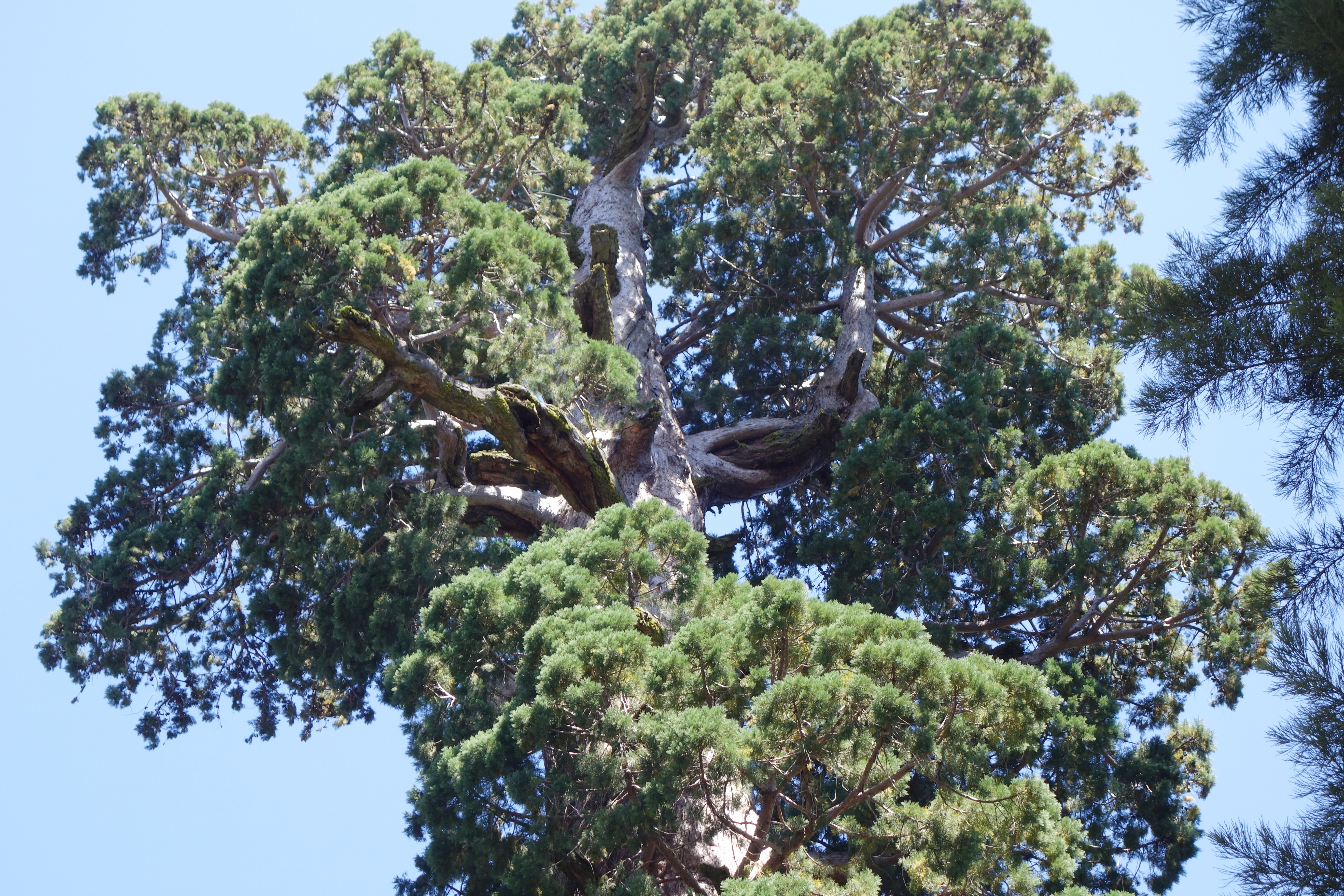
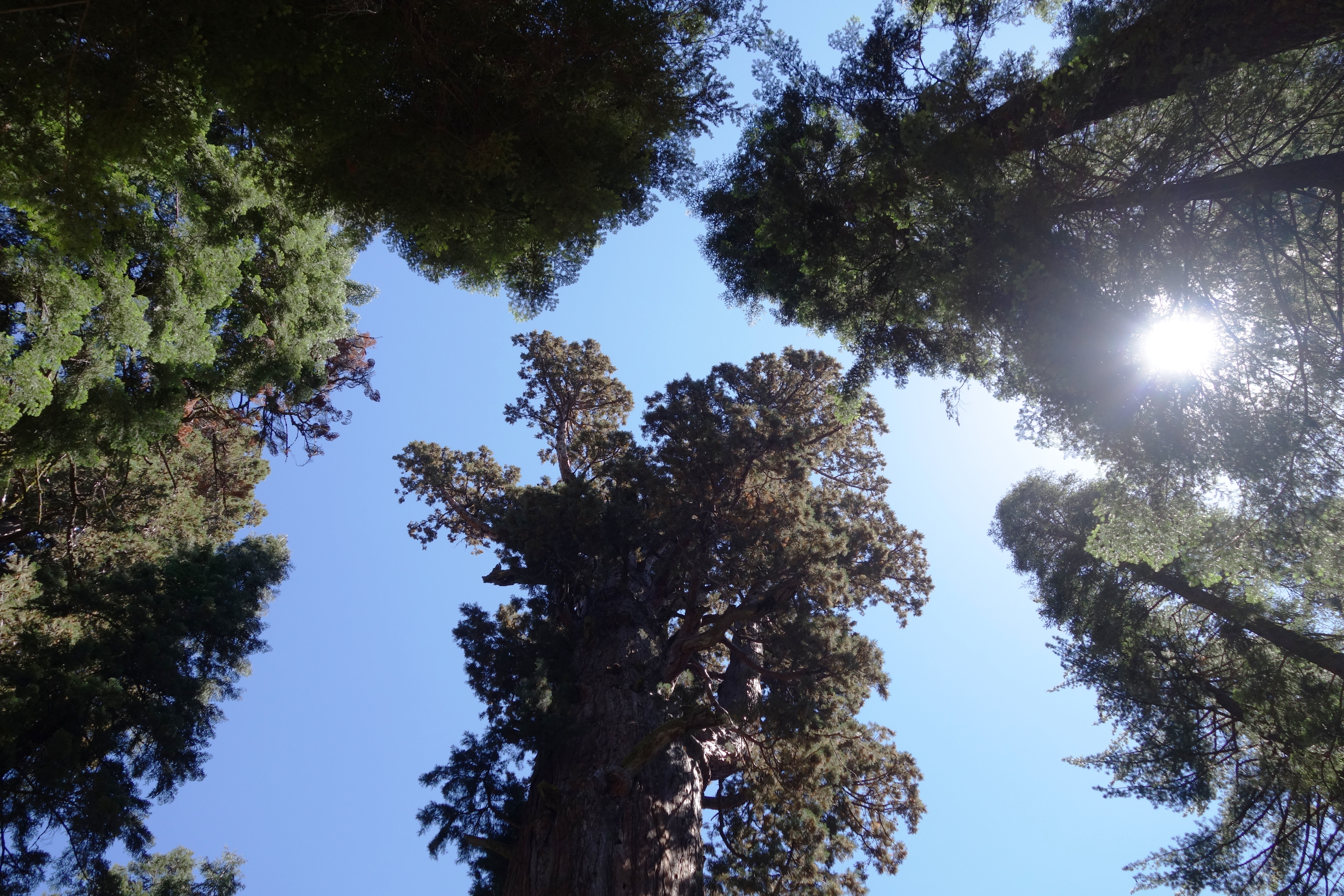
I was in the presence of the bodies of the giants in the Sequoias of Kings Canyon and Sequoia National Park for the first time last weekend.  Being amongst these giants the thought ‘the word trees does not apply’ occurred to me, as it did Steinbeck in ‘Travels with Charley: In Search of America.’  I was calling them beings.  In some visceral way they felt like relatives with whom I’d fallen out of touch and this was an overdue reunion. They reached high into the cobalt blue sky, outstretched arms and rippling biceps busting out of their skin to hold up the canopy. ‘The edge where blue and green play is electric,’ said Chris who spent whole summers growing up amongst their majesty.  The pleasantly scented air, not quite floral and not quite earthy, was constant. When I asked Chris what it was, thinking he’d know the biological origins, he answered ‘goodness’ and another time ‘childhood’. To think that childhood and goodness have a smell is intoxicating in itself.
Canopy

Canopy

fire coals

embers and ash

Later this week, the monthly east bay meeting of Mind Weeds (the term given to meditations with Lin Maslow, a long time teacher within the Zen Hospice Program community) convened at our house. Lin spoke to us of Dogen’s term ‘time-beings’ and  read to us from ‘A Tale for the Time Being: A Novel’ by Ruth Ozeki. He also spoke of how the wood that becomes the ash are distinct time events, not one, and not two. The wood before it burns is not the ash after the fire, each distinct in their moment, like us. Our birth is a time event and each moment that follows its own time event. We use story to string these time events together believing in continuity, solidity, and stability forgetting regularly that everything is change.

This passed Saturday morning at the end of a Nia dance class the teacher, Alexis, read the following quote from Chogyam Trungpa: “Go through it, give into it, experience it. Then the most powerful energies become absolutely workable rather than taking over you, because there is nothing to take over if you are not putting up any resistance.”  Alexis had themed the class on creativity and transformation, inspired by recent thoughts about the Burning Man gathering. She invited us to experience our own creativity and transformation while dancing to the techno playlist she’d made for our class. The joy of being with the bodies of the giants last weekend standing on their trunks of girth, the largest at 103’ at the base, inspired my dance.
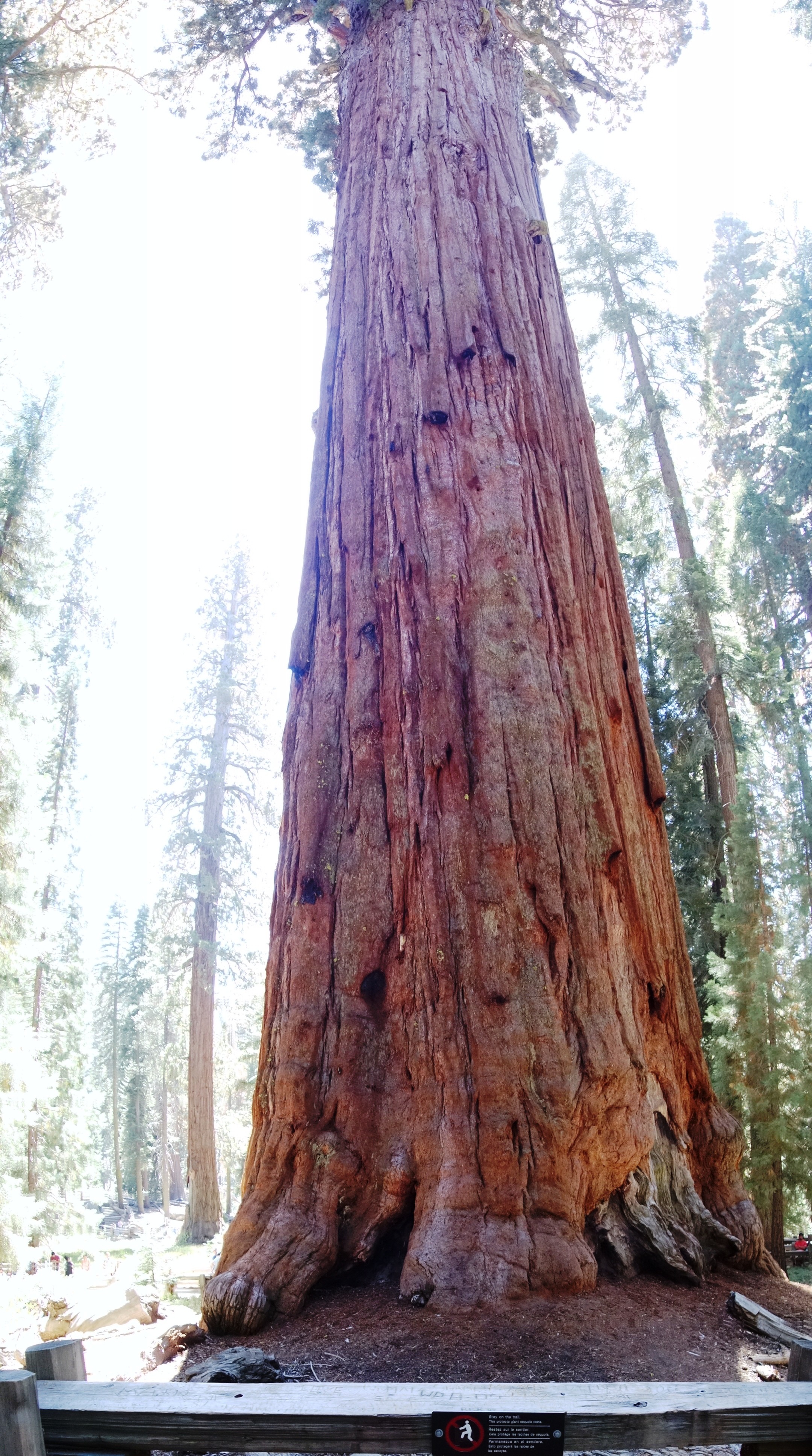
103' at the base

103′ at the base

The dog-eared pages of the September issue of the Sun Magazine  synchronously included an excerpt of ‘Travels with Charley: In Search of America,’ closing with the following passage … “And then the glaciers moved down and wiped the Titans out beyond recovery. And only these few are left – a stunning memory of what the world was like once long ago. Can it be that we do not love to be reminded that we are very young and callow in a world that was old when we came into it? And could there be a strong resistance to the certainty that a living world will continue its stately way when we no longer inhabit it?”

I feel much more at home in the places that offer the deep sense of time described in Steinbeck’s excerpt. It is heartening to think that no matter my achievements or failures, this planet has been spinning and will continue to do so long after this story called Lisa is a memory.  There is still discomfort and restlessness when I think about my own dying. I know we all do, but it is hard to imagine that I will. This coming from a person who has lost a few very important people, trained to be a hospice volunteer, and volunteered weekly for nearly two years to sit with the hospice residents and their families. I participated in ceremonies for the living to honor the loved one that had passed, the corpse lovingly laid out with the artifacts of their living. I’ve also sat with the bodies of residents who died before my shift started and before their bodies were taken away. There is nothing scary about this, though the mystery of how we are animated one moment and gone in the next is a riddle. What is scary is thinking of letting go of this world and the people I love. It is scary to think of leaving this place before I feel like I have really lived.

For most of my life I think I thought that living was doing. This trap is so easily set and equally easy to get caught in. The more I see, visit, accomplish, travel and do, the more I am ‘living.’ And what has become increasingly clear over the passed couple of years is that it is the spirit with which I animate these activities that is essential, not the thing itself.

This isn’t to say that the seeing, visiting, accomplishing, traveling and doing are inherently ‘bad.’ A Rosen bodywork session last September with Alan Fogel revealed an underlying fear about ‘catching’ something of the dying from the hospice residents.  My fear was rooted in a concern that I was not really there for the magic of this lifetime.  He encouraged me to feel my aliveness, reflecting that this aliveness was strong and earthy from his observation.  He suggested that I could bring all of my aliveness to wherever I was, that I could find the place in my body that felt safe and good and make contact with this place at any time. What a revelation this was, to know that this is always available to me, anywhere, anytime.  This magic of being present.

And yet, I routinely forget this option. Continuously abandon myself to external influences and lose myself regularly. Get pulled out of myself into a defensive stance at work with the desire to be recognized, or caught in a family drama that has little do with me, is thousands of miles away but manages to fog my awareness anyway. I bump up against my edges with housemates when I find myself judging what they do, or don’t do. Momentarily elevated by a sense of superiority that only comes crashing when I become aware of this habit of making myself better than and the awareness smacks me down. Rarely do I recall the option to make contact with my aliveness when it would be beneficial for me to be so.

There are external influences that snap me back to my happy place, including the play of light and shadow, when flowers and leaves appear lit from within, and when shafts of light illuminate the cathedral of a redwood forest. The direct and honest observations and expressions of children spark this place too, as does their infectious giggling.

My tendency for consumption is a misplaced sense of wonder expressed by purchasing items I don’t need, eating food I am not hungry for, not allowing time to decompress from varied and rich experiences, or putting a lens between me and something in my line of sight that is alive beyond my desire to consume it.  The time being having a time event that I want to capture and make stay.

This week I also visited with some friends who I haven’t seen in too long a period of time. There are so many people whose company I enjoy, and it is confounding how weeks and months can go by without finding an opportunity to visit. My friend’s mother is living with them and in the time she’s been living with them, her health took a turn and she was subsequently diagnosed with a cancerous tumor on her pancreas. She is 83 and never considered treatment to prolong her life at this stage. Two weekends ago, her illness quickened its pace and things are going faster than my friends expected. She is on an intense regimen of pain management medications which come with the side effect of lots of sleep and the inability to remain lucid for long before the morphine fog is too thick to maintain a narrative. Still, never having met this woman before, catch phrases and her way of saying things offered a glimpse into her character, enough to recognize that she is in a league with my Nanny Laub and my dear friend Jody. Like the plants and flowers mentioned previously, lit from within.

Our lives dwindle and our bodies wilt in this return to the mystery. It awakens sadness and grief for those of us that have to go on living.

I haven’t known how to begin writing about my hospice volunteer experience outside of my journal, or the notes on my iPhone, or the margins of pages during business meetings. It was too big to pull together or too close to articulate. Writing about my experience felt like an appropriation of other people’s dying, and that didn’t feel quite right. And yet being with them was also my experience.

Since March I’ve been on sabbatical from hospice volunteering.  The intention was to use the same block on my calendar to write.  It is so easy to give that block away for the world of doing.  It seems like writing about my experience needed to come in sideways and be mixed in with the experience of being with the giants, some of whom have lived for 3,000 years and more.

The residents I served stay with me in constant dreamlike ways. Magnolia petals always make me think of Nancy. Alfredo, who could make hospital garb look stylish, comes to mind whenever I pass a racetrack. I thought of Ron last week when we climbed to the top of Moro Rock and recalled his stories of philosophizing atop that rock before there was the reinforced experience of steps and cables that Chris and I relied on as we ascended the quarter of a mile to the top, always going up. Wanda, Anh Tu, Muoi, Bernie, and Sharon amongst others were all teachers. As were my shift mates, who were also my friends, and co-volunteers, including Chris.  The volunteers show up weekly and willingly to peak into the mystery and sit with the suffering instead of running in the opposite direction.  This was my edge.  There is nothing to do here, nothing to fix, just a willingness to be present with another time being.

With that, I’m going to let this one go and include one more quote from Chögyam Trungpa:

“Real fearlessness is the product of tenderness. It comes from letting the world tickle your heart, your raw and beautiful heart. You are willing to open up, without resistance or shyness, and face the world. You are willing to share your heart with others.”

Posted in Uncategorized | 1 Comment

A Place of Calm in the Middle of Things (Antelopes in Polar Bear Fur, Dancing Shins and Lakes at the Bottom of the Ocean)

My neighbor John in the apartment building next door to mine keeps his sliding glass door ajar most of the time.  He keeps a basil plant on a table and a couple of chairs randomly oriented around his parcel of deck space.  He drapes his freshly laundered clothes over the chairs to dry them.  Occasionally I see him out there doing some sort of eastern-oriented exercise, like qi gong or tai chi.  Less often I see him sitting out there with company.  Once a very young man, more recently a younger man than John but further along than me.  They were sitting bare-chested in the hot sun, eyes closed.

I know John by name because I introduced myself one day when we were walking up the hill to our co-located apartment buildings.  I had seen him before, observed some of his routines and there was a curiosity, a wanting to know, an affinity of sorts.  On the day of our meeting, he acknowledged my relative youth measured by the pace at which I was taking the hill in comparison to him.  Since then I have learned that as a young man he enjoyed his motorcycle very much, had 17 accidents over the course of his riding career, and a handful of them were severe enough to leave him more fragile than he might otherwise be with the onset of his twilight years.  That doesn’t stop him from regularly walking up and down the hill to go where he goes and tend to his errands.  When I don’t see him for a while I worry.  One of these days we will chat over a cup of tea.

Today John’s door is opened a sliver more than usual and there’s an old school antenna jerry-rigged and fully extended just outside the door. I presume he’s pre-positioning himself to watch the first game of the American League Division Series later this afternoon, OAK @ DET.  The buzz in Oakland is pretty contagious of late, given the history making performance of the Oakland Athletics, even for a non-sports enthusiast like myself.   I tuned into the final game of the season this passed Wednesday and got to hear the Athletics take the game from the Rangers just before heading into a Zen Hospice Project volunteer meeting.

The announcer stated that no team had ever come from 5 games behind to advance 9 games ahead this late in the season.  Add to that the fact that the team is composed of a bunch of rookies, the infectious enthusiasm of one of my co-workers who grew up an A’s fan, and this becomes one of those sports stories cascades, not spills, over into the human story.

So lots of lives will be lived indoors today watching the first game of the playoffs while many others will be lived outdoors, poured into the streets of San Francisco for numerous options and activities.  It is fleet week and the Blue Angels will do their sky dance over the SF Bay. There’s a regatta for the America’s Cup. Hardly Strictly Bluegrass is underway in GG Park and this year they will pay tribute to three founding fathers who passed since the last festival, including the financier Warren Hellman.  There’s the Castro Street Fair, and Litquake events. So many choices it is almost paralyzing, except my dance card was filled in early September by a culture vulture who snatched up some prized tickets to see the Smuin Ballet.

Chris and I will heed all of the warnings to NOT drive into SF today in favor of public transportation.  We will take BART and meander through downtown SF en route to North Beach and eventually the marina on an urban hike.  We will meet friends for dinner in the Marina/Cow Hollow neighborhood, due to the proximity to the Palace of Fine Arts, where we will attend the Smuin Ballet performance.  On the heels of this season’s debut in NYC, the SF Chronicle highlighted this show as one of the major dance picks for the fall.  Performances will be choreographed to music from The Shins Oh, Inverted World, amongst many other acclaimed contemporary musicians (Philip Glass, Paul Simon, Gipsy Kings) and some less contemporary, such as Ravel.  I was particularly thrilled by The Shins piece.  Being familiar with neither Smuin nor The Shins, when I gave Chris the details for his calendar in early September, he cleverly abbreviated the event entry as ‘the dancing shins.’

No yoga this morning, went to a kick butt class last night instead with Skeeter Barker, another master mixer of body meets mind meets spirit.  She brought in a metaphor I used recently when talking with Chris about wanting to trust the deeper flow of the river when the surface gets busy with the turbulence of swirls and eddies.  Skeeter started out the class talking about the chaos unleashed recently in the media following the first presidential debate and how easy it is to buy into the culture of fear.  She likened the fear to the turbulence at the surface of the ocean and meanwhile, way at the bottom of any body of water, there is also the deep calm that is constant.  Specifically, she mentioned the underwater lake at the bottom of the Gulf of Mexico, ‘a half a mile down, over 20 meters long with its own sandy shore, an oasis of life totally independent of the sun’s energy’.  A complete ecosystem and a variety of new species just like what was discovered in the canopies of the giant redwood trees circa 2006, and is wonderfully told by Richard Preston in The Wild Trees.

Skeeter invited us to be both, the chaos and the calm, present with wherever our bodies were at. That invitation stayed with me into the evening and through to this morning.  I woke with strange dreams that involved chaos and fear shrouded in the uniquely creative realm of the subconscious – antelopes masquerading as polar bears, me scrambling to the top of a hotel in Alaska using the branches of a tree to escape the perceived threat of the approaching polar bear, not able to see it was an antelope without the vantage point from the heights of the hotel, feeling trapped by a fear of heights once at the top but at least having the security of something to hold onto, losing a hotel card key and being given a new one for a different room on a higher floor with less favorable accommodations because it was a dorm style floor… getting back to the lobby and finding myself in conversation with Hillary Clinton as a familiar (!).  Waking to discover more and more dreamy details as I spoke the dream aloud to Chris before migrating to the living room for the ritual cups of morning warmth.

A few years ago I discovered a book titled ‘Everybody Needs a Rock,’ written by Byrd Baylor, illustrations by Peter Parnall.  It was so perfect I looked for more and found ‘The Way to Start a Day’ and ‘The Other Way to Listen.’  The latter two are on my coffee table prominently displayed along with recent magazines and some mainstay books.

I’d read ‘The Way to Start a Day’ a few mornings ago and picked up ‘The Other Way to Listen’ this morning, tilting the book to show Chris a page or two.  As described on this Scholastic page, ‘a girl knew an old man who had a special way of listening. He could walk by a cornfield and actually hear the corn singing, and once, he even heard wildflower seeds bursting open, beginning to grow underground. The girl asked the man to teach her to listen, but he said she had to learn how from the hills, ants, lizards, and weeds. For a long time, she tried without success, and she almost gave up. But then, one day, she began a joyous song to the hills and, without even trying, she discovered the secret of the other way to listen.’

The lake at the bottom of the ocean, the canopy 330 feet in the air at the tops of the tallest redwood trees, the other way to listen, a place of calm in the middle of things.

Posted in Uncategorized | Leave a comment

the magic of making bread

A few Sundays ago I made bread.  It was the kind of day that called for such a meditation.   It was a morning that started with discord and stretched out into hours of processing, misunderstandings and miscommunication, listening but not hearing, learning the language of relationship without the he said she said, the scenes that Hollywood films spare you as they splice together the make-up scenes and gloss over the hours in between.

I turned to my tattered Tassajara Bread Book, a Christmas gift from a roommate in 1994.  Originally authored by Edward Espe Brown in 1970, the version I have is revised and updated as of 1986.  If you read the ‘About Ed Brown’ page at the end of the book you learn about the many roles he served in relation to Tassajara Zen Monastery, the Zen Center in San Francisco, the Zen Center’s well-known restaurant, Green’s, at Fort Mason in San Francisco, and at Green Gulch off of Highway 1 in Marin County.

Sometime after I was gifted this book in the latter part of the 90s, I took a cooking class with Ed Brown.  He was very charming and funny, in fact I’m pretty sure he still is.  We made lentil soup and a pear tart using recipes from his book titled Tomato Blessings and Radish Teachings: Recipes and Reflections.  I bought the book that day, as well as a vegetable knife that is my favorite knife to this day.  He signed the book for me with a blessing that reads, ‘for Lisa – May your heart be nourished, your spirit lifted, in the kitchen and out – feasting on your life.’  In some ways that feels like more like a fortune looking back over the years since.

He taught us how to clean and chop cilantro for the soup, including suggestions on how to  use a knife properly.  Some of the students were not following his instruction.  He did not point out who they were, he just stated, and I paraphrase ‘you know, I teach these classes assuming people want to learn new ways of doing things, but if you want to pay to take my class and continue to do things the way you’ve always done them, well that’s your prerogative.’  That tickled me silly and I think of it whenever I prepare meals using recipes from his books, his voice and the tone used when he made that comment resonate and make me smile.  He is a wonderful writer who folds Zen teachings into his recipes.

I was introduced to Buddhism when I was 21 by a woman named Susan Dey.  She had a degenerative disease that was gradually taking away her abilities and she needed assistance with the activities of daily living.  She hired me to do things like feed her cats, help her get dressed, prepare her meals, take her out to do things in NYC, and read to her.  She had memberships to museums and got special entrance to performances due to her disabilities.  Those were definitely my salad days and I like to think that I appreciated the ‘culture vulture’ access she gave me.   But that might be casting a rosy glow, because truth be told, I resisted many of the lessons she offered and the tasks she put before me.  For instance, I found it irritating that she wanted me to do things like heat the cat food on the stove.  Cat food stinks before you add heat to it!  We dialogued about this one day and she brought in the concept of compassion, asking me if it wasn’t right to offer the comfort of heated food to the cats the way I enjoyed heated food.  This is still pretty fresh 24 years later, so it seems to have made an impression.

She asked me to read to her from Chögyam Trungpa Rinpoche’s book titled The Myth of Freedom and the Way of Meditation.  I remember being similarly frustrated.   The ‘myth’ of freedom did not find an easy place to land in my 21 year old brain that was busy busting out for freedom in every direction.

But, ten years later, I was learning to make bread, soup and tarts from Edward Brown.  A quote from Wikipedia says that Brown tells his students that, “every dough is different, just as every day is different.” And that gets to why that Sunday a few weeks ago was a bread baking kind of day.

There is magic in making bread the old-fashioned way, aka sans bread machine.  The magic of the yeast, hoping that you get it right with the water temperature, not over kneading, and having patience with the process are all wonderful opportunities to practice faith and trust. Once you commit to making bread you are house bound for hours to allow for the risings, the punch downs, the risings, and the shapings until the baking which results in one of the most pleasing aromas my nose knows.  In fact, when I am on my death bed, I want to smell bread baking even when I am past the point of eating.  I want to be in a place where sunlight streams in and sounds from outside drift in.  And please, if you have any influence over the music that is playing, make sure Wilco is on heavy rotation in whatever playlist happens to be cycling through.

I say these things now knowing that just like any plans, you have to hold them loosely, “completely let go and not struggle against change, because when we can embrace the groundlessness of our situation and relax into its dynamic quality, that’s called enlightenment, or awakening to our true nature, to our fundamental goodness.” An excerpt from a Pema Chodron quote that I am thinking of having tattooed on my body – how’s that for impermanence?

Posted in Uncategorized | Leave a comment

Perfectly Imperfect

Tonight is the full moon and it is a harvest moon.  The first time I visited California with my cousin Cathy to stay with her brother Robert we had dinner in Sausalito on the evening of the harvest moon.  The orangey waxy super-sized ball of an orb came up over the east bay looking superimposed, over-acted and theatrical.  It tempted us to want to touch it and almost believe that we might be able to if we were out in the bay on a boat with a ladder long enough.

This morning, the substitute teacher for the deep flow yoga class at Namaste brought this concept of fullness into class with his instruction, the chanting, the breathing and an invitation to let every moment be full and perfect in its imperfection.   This called to mind the Suzuki Roshi quote that we are perfect as we are, and, there’s always room for improvement.  Each moment, each person holds this paradox.

This was my third yoga class for the week and it feels mighty good to be back at that pace; it has been a while.  The pause to just be in my body for 90 minutes, hold an intention for my practice, focus and feel strength in my muscles transforms into confidence not only in my life, but in life itself.  Without this pause, the committee and chorus of my mind chatters and clatters like commuter traffic in Grand Central station, an elevated din making it impossible to drop in.  And the traffic is a ruse, of course, distracting me from the terror just below.

Impermanence has made itself known lately, serving up more changes than is comfortable or digestible, and making it impossible for me to skate on the surface of pretend.  Three of the four heavenly messengers, namely old age, sickness and death, e.g. the ones that greeted Buddha (while he was still Siddhartha) after he stepped outside the palace walls have been circling very close.  And I have been resistant to let go into the fourth messenger, awakening.  I have done what is incredibly human to do, respond with fear and hold on for dear life, white knuckles and all.  A futile attempt to not feel the pain and sadness and grief unleashed by bereavement in so many lives around me, not only the bereavement for the loss of loved ones, but also the bereavement that begins with diagnosis.   Resisting, instead of going with, the flow however, can only last so long.  As Marion Rosen liked to point out, the strongest muscle is the relaxed muscle.  The contracted muscle is already spent.

There are numerous reserves of support, including Chris, my partner in crime since June.  He has been exceedingly generous with opening his arms to me, offering a harbor in the storm.  His patient, kind and compassionate love offers all kinds of space, a field to play in like I’ve never had before in an intimate relationship.   Seasoned and shaped by some true character-building opportunities, a veteran at letting go, he knows on a visceral level that there is nothing to hold onto, really.  Most recently informed by a sudden cardiac arrest that he survived in March 2011 he knows that life is impermanent at a cellular level.  He is not your average bear.

And yet there’s the play of life, the drama we project onto the screen, the stories we tell ourselves and get pulled into that take us away from the more ephemeral underlying truisms.  We get sucked in, stand in lines for roller coasters and lattes, stress out over bills, worry about our loved ones, and plan our lives by weeks, months and years.

So this new love has become my opportunity to practice in many ways.  I get to visit with my demons in this new field where love is patient and love is kind.   To see the less than glowing aspects of myself in a more gentle way affording me the opportunity to make some changes from the inside out.  The foundation we’ve been building, in concert with my hospice volunteer work, is tilling the soil to plant new seeds. Ever so slowly I am learning to relax into the falling with the understanding that there is nothing to fall into.  And, while I’ve missed writing in the long, wandering ways these blog entries take me, seaming together narratives from fragments and pieces of paper, and I’ve missed going to yoga 3 or 4 times a week, I have relished learning a new language of relationship with Chris. Perfectly imperfect in our fullness, it is a marvelous night for a moon dance.

**

On a side note, one of my co-volunteers from the Zen Hospice Project, Tom Nickel, presented to the American Counseling Association at their annual conference earlier this year on the subject of helping clients prepare for end of life, the final chapter.  The Association followed up with an article in Counseling Today and it is well worth a read.  We all get to that final chapter eventually, whether we go kicking and screaming full of resistance or relaxing into the wave and going with the flow.  You can read Tom’s article here.

Posted in Uncategorized | Leave a comment

The 6th Hour, An Emptiness That Feels Full

It is a big wordless kind of tired that follows my Monday afternoon volunteer shift with the Zen Hospice Project at Laguna Honda Hospital.  An emptiness that feels full.  It has been a month and  half since my first shift.  The residents, their families, and the other volunteers are seeping into my general awareness, staying with me throughout the week like characters in a novel that I can’t put down.

We were invited with one of the five precepts that were integral to our hospice training to bring our whole self to the bedside.  This means putting aside roles and ideas about who or how we think we should be, and allowing ourselves to show up in that alchemical way that is more than the sum of our parts.  The experience of serving residents and their families during the dying process becomes a dense matrix of manifold dimensions with each passing week.  The softening, sensitizing, letting go, grief, pain, surrender, willingness, trust, sadness – the complexity of who we are in any given moment is remarkable.  And, it is constantly shifting.  It is so easy to get attached to ideas about how we think things are supposed to be, who we are supposed to be, and who others are supposed to be.

Last week on a gorgeous sunny morning, I sat outside of a cafe on Lake Shore while the day ratcheted towards productivity.  Commuters, construction, and deliveries, lots of noise and slow-going traffic.  There was a man with a mechanized hand-truck and a palette of fifty sacks of flour, at fifty pounds each, destined for the cafe I was seated at.  Due to the construction, his usual way of zipping in and out of the cafe to make his delivery was obstructed.  He had to come up with a Plan B.  He was visibly unhappy about this change in plans.  The solution was to place an empty palette on the level of the cafe, maneuver the hand-truck as close to the curb as possible at the street level (through the construction, morning commuters, dogs, bicyclists, etc.), unload the carefully constructed piles of flour sacks from the street-level palette and manually reload them to the empty palette.  This took more time than he had planned, and it was not how the day was supposed to go.

Regardless of the steps to get from A to B, the job(s) ahead of him for the day involved delivering baking supplies to various establishments.  That much he knew when he showed up for work that day.  He had a body to do the work, a mechanized hand-truck to minimize the manual labor, a brain to problem solve, and a blue sky day.  I watched as he let this situation completely cloud the forecast for the rest of the day and thought about how often I do this same exact thing to myself, from the micro to the macro level.

The weekly immersion into gratitude afforded by volunteering with ZHP stirs all kinds of feelings, thoughts, and emotions.  The words from a yoga class last fall scroll through my head regularly, as follows, ‘this body, this breath, this moment, this life – may we never take them for granted.’  It is an embodied awareness to realize that grief is the other side of gratitude.

The precept of bringing my whole self to the bedside, like many other of the teachings stemming from this experience, is spilling over into the rest of my life.  Writing down the precepts before giving a presentation at a conference a few weeks ago, along with doing some breathing exercises, helped me to get back into my body instead of staying in the disconnected, freaked-out spasm of worry and performance anxiety in my brain.  It was a revelation to bring these skill sets into a completely other setting, and rewarding to boot.  It was the most fun I have had yet giving a presentation!

**

It is the season of graduation.  Before departing for the aforementioned conference a few weeks ago, I attended one of my favorite yoga classes on a Saturday morning with David Moreno in Oakland.  He read excerpts from a commencement speech Anne Lamott had given at U.C. Berkeley in 2003.  I highly recommend reading the speech.  It is full of humor, insight, and invitations, such as,

“Your problem is how you are going to spend this one odd and precious life you have been issued. Whether you’re going to spend it trying to look good and creating the illusion that you have power over people and circumstances, or whether you are going to taste it, enjoy it and find out the truth about who you are.”

At the end of the class, feeling integrated, embodied and ready for a shower, savoring the last seconds of shavasana, David declared that we were graduated and he read the final paragraphs of Anne Lamott’s speech, as follows:

“You’ve graduated. You have nothing left to prove, and besides, it’s a fool’s game. If you agree to play, you’ve already lost. It’s Charlie Brown and Lucy, with the football. If you keep getting back on the field, they win. There are so many great things to do right now. Write. Sing. Rest. Eat cherries. Register voters. And — oh my God — I nearly forgot the most important thing: refuse to wear uncomfortable pants, even if they make you look really thin. Promise me you’ll never wear pants that bind or tug or hurt, pants that have an opinion about how much you’ve just eaten. The pants may be lying! There is way too much lying and scolding going on politically right now without your pants getting in on the act, too.

“So bless you. You’ve done an amazing thing. And you are loved; you are capable of lives of great joy and meaning. It’s what you are made of. And it’s what you’re for. So take care of yourselves; take care of each other. ”

**

Last Tuesday, a beaten-up padded envelope from the Gift of Life was on my welcome mat when I arrived home from my first all-volunteer meeting with the community that serves the Zen Hospice Project.  Our discussion was based around the question of what do we do with what we know about those we serve.  It was a layered conversation that functioned more like a koan than a pursuit of the right answer.  It is amazing how conditioned we are to think there is a right answer.

The envelope contained a commemorative Gift of Life Donor lapel pin and a thank you card from the director of donor services.  On the morning of May 14, the call came informing me that the recipient of my bone marrow had survived, was disease free and did not require a re-transplant.  Carrying this information with me into my second shift as a hospice volunteer was magical.  This news was so life-affirming and miraculous it had the affect of sweeping away anything that felt remotely like doubt.  Of course these states of mind don’t stay.  I am starting to believe, however, that with some assistance and discipline, gentleness and compassion, these more positive states of mind linger for longer periods of time, nudging the critic, the cynic, and the jury aside.

**

During our hospice training, the volunteer coordinators and facilitators  encouraged us to take a 6th hour after our shift to acclimate, to be gentle with ourselves before re-entering the fray.  Prone to date-stacking, it is unlike me to keep blocks of time open on my social calendar.   This experience is so entire in how it takes me that I don’t have a choice.

There is no right answer.  Bring your whole self to the edge of your experience.  Take care of yourself, and each other.

Namaste

Posted in Uncategorized | Leave a comment

One Year Anniversary

This afternoon, a representative from the Gift of Life called to check in on me as today marks the one year anniversary of my bone marrow donation to an anonymous recipient.  The recipient is still anonymous, and the outcome unknown.  The transplant center that managed the donation has not yet responded to communications from the Gift of Life regarding my donation.  Today might be different though due to the one year mark, I hope.  All transplant centers have different protocols, she told me.  I requested to know the outcome, either way.  If the news is positive, and the person is interested in connecting, it is exciting to think of that meeting.  What exactly does it mean that we are genetically similar enough to share DNA?  I want to know what that looks like!

The thought that I would be a volunteer with the Zen Hospice Project within one year’s passing is not surprising, it just wasn’t on the radar a year ago at this time.  I am not making a connection between the two.  And at the same time it is curious that my first volunteer shift at ZHP occurred the same week as the one-year anniversary of the donation.

There’s no denying the fact that I am drawn to the portals.  The intimacy that happens with birth and with death brings a permission to be honest in a way that we are not afforded in daily life, generally.  That edge and honesty is appealing, the candor refreshing.  Meaty conversations that get to the heart of the matter are where I like to live.  And to stand with someone in their mystery, in their suffering, to be present with someone as they find the way through the darkness will be a privilege and an education. It will challenge all of the conditioning in me that wants to fix.  To know there is nothing to fix, no place to be, just present in the moment with the suffering, a trustworthy companion.

Choosing to come face-to-face with the dying process will be a weekly invitation to see death as a life-affirming and transformative process, no time to lose.  I was given this inkling when Jody was dying in 2009.  Being part of that journey was a gift and she cleared a path for me in many ways.  The month-long sojourn in India offered the opportunity to take a step back from the dailiness and see the road ahead with a long-view perspective.  If I want to be doing something different 5 to 10 years from now, laying the groundwork needs to start now.  She also held up a mirror for me to see all of the places where I will not fair so well with my own sickness and dying.  Unless I start softening now, finding strength in my vulnerability now, learning to surrender through practice, intention, and awareness, I am going to suck at being a not-well person.

A few years back I took an improv class with Bay Area Theater Sports.  The goal was to loosen up and have more fun with public speaking.  It turned out to be some of the most fun I have had as an adult.  Those classes were the highlight of my week!  The first rule of improv is to always say yes.  Yes keeps the story going and the possibilities are endless.  Seems to be working…

Posted in Uncategorized | 1 Comment

May Day in Oakland

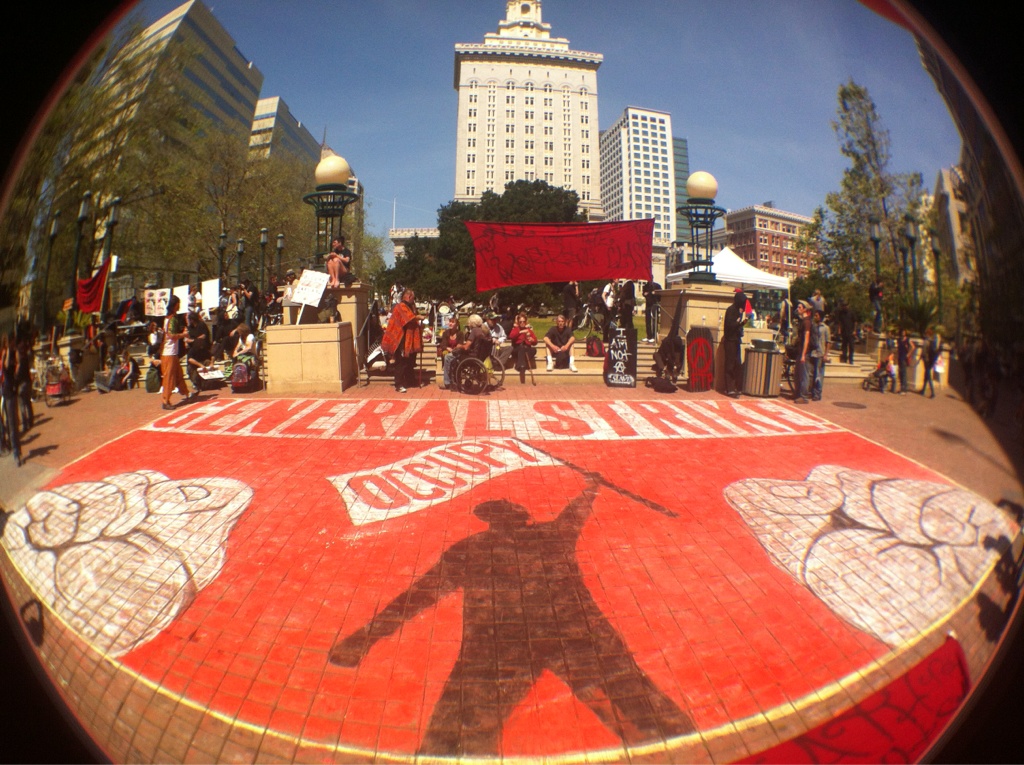
11:05 p.m. and the helicopters are still constant overhead.  I occupied a chair in my dining room for most of the day while logged into my work e-mail, opting not to go into the office. The building I work in was in ‘secure mode’ all day as a preventative measure for dual purposes, a potential strike of the Bay Area Maintenance Contractors, directly impacting our building, within the larger context of the May 1st Occupy Oakland activities.  I did not want to cross the picket line and be caught carrying on with ‘business as usual,’ and sat at home with my guilt and passive support instead.

A variety of tabs were open from my browser so I could safely monitor the photos, tweets, and myriad perspectives of the Occupy activities throughout the day.  Incidentally, there was also a bomb threat at the elementary school in Virginia where one of my nieces and two of my nephews attend school.  I caught that going by from a Facebook update.  The gist of of the Facebook update was that it was the stupidest day ever.  The worst part, from the kids’ perspective, was that several kids were evacuated without being given the chance to collect their cell phones.  The equivalent of losing a limb, essentially.  Turns out that it was only a threat, but we all know you can’t take those things lightly.

This day has a long history in the U.S., dating back to 1864 when there was a nation-wide movement that involved workers agitating for an eight-hour work day.   As summarized in an article titled May Day’s Radical History, the Occupy actions planned for today are tied to the generations-long movement for the eight-hour day, to immigrant workers, to police brutality and repression of the labor movement.

Occupy Wall Street in NYC had its own page of activities, and the tag line on the site reads ‘OWS Stands in Solidarity with the Calls for a Day Without the 99%.’  There was a coordination cheat sheet and opportunities to participate in free market systems, learn-ins, free university to actualize the education we want to see, and an invitation to 1,000 guitarists  to join Occupy Guitarmy and rock out during a march from Bryant Park to Union Square.  There was even a suggested “vacation note” you could use for your Twitter, Facebook, or personal website that read: May Day is a day for the 99% to celebrate the value of their work and lives. I have taken to the streets, and so should you!

The Occupy Oakland camp set up a website purely for today’s activities under the banner of May 1st General Strike – Bay Area May Day Clearinghouse, imploring no work, no school, no business as usual.  Activities were stationed around anti-capitalism, anti-patriarchy, and anti-gentrification in three decentralized locations throughout Oakland with the goal that the different groups would converge in one massive march to a rally later in the day.  From what I read via the Occupy Oakland stream of tweets, this was largely accomplished, albeit with some riot-clad police, tear gas, and even a tank heading down Broadway mid-afternoon.  Links at the bottom of this Clearinghouse page take you to similar events organized in Chicago, Seattle, Los Angeles, and even a link to STRIKE EVERYWHERE, a global general strike.  If the media or talking heads of any description, political or otherwise, want to portray these activities as the tag line from Scooby Doo, aka if it wasn’t for you meddling kids, it would be less than accurate.

Time magazine awarded Person of the Year 2011 to The Protestor.  Between the cascade of revolutions in the Middle East that began with an average citizen setting himself on fire in Tunisia in response to police bureaucracy getting in the way of his livelihood (while the extravagances of the dictatorship were openly displayed) to the dominoes that continued to fall into Europe and across the Atlantic to the U.S. this revolution is being televised, and tweeted.

The methods and factions of the Occupy movement splinter off from the unifying sentiment of frustration at economic inequality and corporate greed.  There’s no easy way to take on big institutions, right?  Banging on the doors of Bank of America and Wells Fargo branches and terrifying the onsite staff is one form of expression, I suppose, though it isn’t my style.  That would be the bottom up approach.  The top down approach seems to look more like the Buffet Rule, which would amount to no household making more than $1 million each year would pay a smaller share of their income in taxes than a middle class family pays.  Sounds pretty good to me, and there seem to be more than a few well-heeled, deep-pocketed millionaires that are okay with that also.  But neither the bottom up or the top down approach have gotten much traction.  So the faceless masses of Occupy keep organizing creative disruptions until something gives.

Anarchist episodes of violence are to be expected.  That seems to always be the case with any rally or march.  And the media loves that stuff, so unfortunately the majority of news-consumers get a stilted view of how these creative disruptions play out.  Occupy discussions can easily polarize a dinner party conversation and a casual Facebook exchange can turn ugly.   Ultimately, I think the discussions taking place because of the Occupy movement are a good thing.  There are no easy answers, but at least all of the -isms are under scrutiny.  A new umbrella term that encapsulates the Occupy movement pretty efficiently is the word corporatocracy.  It is so new that WordPress is suggesting it isn’t a word with a red squiggly underline.

I support the Occupy movement and consider myself part of the 99%.  On April 5th, I had the dizzying, life-altering experience of appearing in a court of law to have my Chapter 13 bankruptcy petition reviewed.  The mortgage I held for a condo in Virginia was upside down with no hope of recovery any time soon, and the rent received on a monthly basis for that property was $400 shy of my obligations.  That was the math for 4+ years.  When I tried to re-mortgage, BofA couldn’t help me because they viewed my condo as a second home, so the lending conditions were more stringent and out of my reach.  On top of other debts, I was up against the wall by last July.  Numbers fell in my head trying to find a way to fit like a game of Tetris when I tried to go to sleep at night.

When I met with legal counsel last December, the lawyer assured me that unless I was an heiress to an inheritance or planned on winning the lottery, I was never going to get out from under the debt.  In situations like mine, bankruptcy is meant to offer a fresh start.  It was a forced march to get through the mountain of paperwork required of the process.  For once I was grateful for my pack rat-tendencies.  I half expected that upon checking in at the court room where I was required to swear in under a prominent Department of Justice seal, that they would hand me a sweater with a big scarlet letter on the front.  It was all very formulaic, and the trustee really was on the side of justice, an advocate for the debtors when needed as much as she was an arbiter in search of clarity for correctly filed petitions.

As a prerequisite to declaring bankruptcy, I had to take an online credit counseling course that should be MANDATORY for everyone graduating from high school.  Unless you grow up in a household where money management is overt, the credit card industry has the intoxicating ability to eat you alive.  It kind of reminds me of a response Ricki Lee Jones provided to a question about her stint with drugs.  She said, “The funny thing about drugs is you’re doing them until (pregnant pause) one day they’re doing you.”

It is taking me a while to re-story around this.  When the lawyer saw me fretting back in December, he asked about my reservations.  I told him I was never going to do something like this, I am the responsible one, the good girl.  He re-asserted the stark truth about how I’d never get out from under the debt, and said, ‘Trust me, the banks don’t have these issues.’  It became clear that it was unsustainable and that the life of an indentured servant wasn’t for me.  Now, I can’t wait to have a bonfire to burn statements kept on file for years.

The RSS feeds streaming through the Occupy Oakland site tonight said things like, ‘Total civil unrest in Oakland tonight, cops and copters all over, occupiers everywhere, scattered arrests, police not in control.’   One article I read about pre-May Day activities on April 30 turned toward vandalism in the Mission District, San Francisco, noted, ‘Whether Occupy identifies with these rioters or not, these rioters identify with Occupy.’

There are many ways to identify with this movement, even if you don’t agree with some of its manifestations.  The quick to judge, casual observer may err on the side of saying something like, ‘if they have time to be out on the streets, they have time to get a job.’  If that observer gets their news from a major news network, stretching that perspective to consider that perhaps the sensationalized bits might be the Agent Provocateur instead of the Anarchist might be a good push-up for the brain.  This movement has many faces, and the anarchists are a visible minority.

It is miserable that small businesses have been damaged, and that city budgets have been stretched to manage the disruptions to business (and busy-ness) as usual.  As noted, I did not take to the streets and my conscience wrestled with whether or not I should be out on the streets doing something.

But then I went to my yoga class tonight.  Yoga meaning union, the individual soul with the universal spirit.  And right there in the class with me was Angela Davis, professor emerita UC Santa Cruz, and one of the hallmark nationally prominent activists from the 1960s.    The East Bay Express featured an article on Angela Davis and Grace Lee Boggs titled, “Angela Davis and Grace Lee Boggs Ponder Activism in the Age of Occupy,” in tandem with a recent speaking engagement at UC Berkeley to kick off the Empowering Women of Color Conference.  The article explores ‘protest organizing’ versus ‘visionary organizing,’ and explores what revolution means in this day and age.  Ms. Davis was gracefully following the instruction from one pose to the next instead of standing at a podium in Frank Ogawa Plaza in downtown Oakland.  This fact gave me pause to consider that there is even more to re-story, and that re-story can include visionary organizing AND downward dogs.

Posted in Uncategorized | 6 Comments

pieces of paper

Today was one of four days a year when I drive from Oakland to Walnut Creek to use the lifetime of free oil changes that came with the purchase of my vehicle five years ago, provided I go to a dealership.  The BART ride back to work gives me that commuter opportunity to read.  This morning’s commute came with the added bonus of an overcast sky, intermittent showers and a rainbow in full bloom arching over hills blanketed with baby fresh green grass and bursts of yellow clover.  The April issue of The Sun magazine was my companion, and it opened at its stapled center to offer a story titled Benedicta.  There was just enough time to read this story and the poem that followed, titled Getting Ready.  Both were about death, and lovely.

The mood caught me.  Instead of heading straight to the office, I ventured into Cafe Madrid and enjoyed a second Americano.  There was a couple with big red luggage watching the morning passersby at 20th & Broadway.  The woman at the counter used the terms ‘hon’ and ‘sweetie’ when speaking with the clientele and it worked.  Her endearments were a welcome reminder of our human longing for connection.

The story and poem in The Sun stirred in me.  Benedicta is a story from a granddaughter who has gone to be with her grandmother’s body at the nursing home where she passed away to await the funeral home workers coming to collect the body. Her grandmother was 92.  Benedicta is a woman in the hallways whose memory works in 60 second loops.  She is constantly asking to be reminded of her whereabouts, the date, her name.  The author, Sarah Braunstein, explores the concept of consciousness, how it leaves us all eventually.

My Nanny is 92.  I am beyond grateful to have had her in my life as long as I have, never tire of her stories that evoke a different time, people I’ve never met, her joys and sorrows, loves and losses.  I love her voice, watching the emotion pass over her face, and her turns of phrase.  The most recent visit the week before last was hard.  To see her so uncomfortable in her body, and now her confusion too.  She has outlived all of her siblings, the majority of her friends, and her only son, my father.  She has lived through nine decades of rapid change.  She is tired, frustrated, and seemingly close to done.  It is a full life.

Also, I think of my dear friend Richa whose grandmother, Nanima, passed yesterday.  Nanima witnessed and was an active participant in the events of the same decades my grandmother passed through, though from a vastly different set of circumstances in India.  I am equally grateful to have known Nanima through Richa.  She was an amazing woman.  A matriarch whose stories will live on in many.  An attempt to capture a small fraction of her life is here.

Last weekend the web of connection was palpable in a room full of trainees being initiated into the community of volunteers that serve residents of the Guest House and Laguna Honda Hospital as part of the Zen Hospice Project.  It will be a great honor to serve in this community.  Our wholehearted teachers offered that loss connects us all.  Grief is something we own, something we feel in our bodies as a unifying experience.   We were asked to participate in one of the more profound exercises of the weekend by writing to someone we’d lost through death or separation.  Then we were invited to share our grief and vulnerability with the group by reading what we’d written out loud.  It was impossible for me to choose between writing to Jody or to my father, so I wrote a letter to each of them.

During my interview to volunteer with the Zen Hospice Project, I was asked where I feel grief in my body.  Did it have a color?  A texture?  These questions cracked open the raw emotion of missing my father, and the tears flowed.  I asked if there were rules around crying at Zen Hospice.  My interviewer, Eric, responded with generous laughter that held me like an embrace and extended the following invitation, ‘bring all of your grief, let it be true.’

We live in a culture that doesn’t honor grief.  Most employers offer a few days of bereavement pay for the loss of an immediate relative, but there’s a pervasive awkwardness around our ability to dialogue about our experiences of loss.  And the more it gets stuffed down, the more feelings of being cut off set in, the potential for alienation grows.  You just want someone to let it to be true.  Grief is a fog that needs time to lift.

The training to volunteer with the Zen Hospice Project is much more about learning how to live than it is about dying.  The service is built on the premise that everyone deserves to die surrounded by love.  Ram Dass wrote the following in the preface to Stephen Levine’s book titled, ‘Who Dies?’: The new hospice movement focuses on providing a warm, supportive, and open environment for the individual undergoing the dying process.  With the Zen Hospice Project, the family of the individual is also brought into the fold.

Here’s what dying in the U.S. looks like, as reported by the onsite doctor at Laguna Honda who manages the palliative care: 57% of us will die in hospitals, 17% in nursing homes, 20% at home, and 6% other.  The majority of deaths are managed with clinical (or curative) care, and not palliative care.  Clinical care is largely about managing the physical aspects of someone’s health, and more often than not omits the psychosocial, emotional, and spiritual components.  As part of our Zen Hospice Project training, we are learning how to turn towards the dying with wholeheartedness.  To trust that there is nothing that needs fixing, changing, healing or correcting.  In this there is the chance of providing a container that supports the full spirit, instead of contributing to the brokenness.   I can’t think of a better way to live.

The founding director, Frank Ostaseski, developed five precepts that stand like pillars throughout the training.  They are:

  1. Welcome Everything.  Push Nothing Away.
  2. Bring Your Whole Self to the Experience.
  3. Don’t Wait.
  4. Find a Place of Rest in the Middle of Things.
  5. Cultivate Don’t-Know Mind.

Again, I can’t think of a better way to live.

The weeks and months leading up the training were packed with activity.  It took me until the third day of our training to fully arrive and one exercise in particular grabbed me. It involved sixteen post-it notes dispersed in sets of four different colors.  On one color we were asked to write the names of four people we held dear.  On another color we were asked to write four possessions we love or use daily.  On the third color we were asked to write an activity we love, and on the fourth we were to write a role or a relationship we have in our lives.  Then we were asked to fan these sheets of paper out before us and to take it all in.  And then we were asked to choose one of each color – a person, an activity, a possession and a role.  One of our teachers came around with a basket, bowed in front of us and we had to let go of this grouping.  For me, the ritual around this exercise and the way in which it was conducted imparted a very real sense of loss.  Then we were instructed to choose four any color for the next wave of loss.  In the final round, we did not have to choose anything.  There was an impulse to leave the room, or hide the post-it notes that were left.  But I stayed and one of our teachers, a current volunteer, in the role of Kali randomly swiped post-it notes from us.  Following each round of loss we were asked if what we were left with was enough. Vitality, vigor, planning, future – these things all leave us eventually. How will we manage?

I have built my identity around independence and activity, the doing more than the being.  To do lists constantly re-surface as evidence of all these things that I’ve done. It reminds me of the last line of The Shins Simple Song, which is… ‘its such a delicate thing that we do, with nothing to prove, which I never knew.’

The next year will have its way with me, I am certain.

Dear Dad,

I miss your certitude, your confidence, and the unwavering infrastructure you gave to my life.  The world without you is a different and more scary place.  I could always count on you to offer up supportive statements such as, ‘get your head out of your ass,’ or ‘stop fucking around,’ or ‘Lisa Marie, you’re too deep for me.’  While you were alive these offerings infuriated me, made me bang at your door to be understood.  And now, I miss your ability to pull me up out of my depths with your harsh invitations.  And after you died, visitor after visitor at your services told me how proud you were of me.  And the dreams that came after you died, for years, told me that too.

I would say to you now that I love you.  That there’s lots of fantastic new music I wish I could share with you.  That I’m figuring it out slowly, in my own time and you don’t have to worry.  I’ve got bennies and a regular salary.  And I’m very sorry that I didn’t call you from Ireland when it turned to the year 2000, I had no idea you were waiting for that call and I’m sorry that hurt you.

I would ask for a hug.  And I would thank you for loving me the best way you knew how.

Posted in Uncategorized | 6 Comments

back in the saddle

Hard to believe that tomorrow evening will mark one month of being back in the saddle.  That’s been the catch phrase playing like a refrain in my brain, as in doing something you stopped doing for a while.  You know, like working, waking up to alarm clocks, laundry, shopping, dishes, that kind of stuff.  Not meant to be a reference to the Top 40 Aerosmith song (you are welcome for that ear worm) or the Gene Autry signature western.  On that note, it must be said that one of the more entertaining byproducts from writing these entries is the inferential galavanting and traipsing on the internet for references.

A friend pointed out last night that I will have been home now for as long as I was gone.  Just like that.  How is it possible that one unit of time  measured against that same measure can be so remarkably different?

Travel drains the soggy cornflakes of the dailiness, everything is new, you get a clean pair of eyes every day.  For a solid month, my curiosity and gaze were on par with being in a museum, perpetually.  Not surprisingly, re-entering the dailiness has been bumpy.  And the physical adjustments, such as jet lag and digestive tract lag have exacerbated the bumps.  It took a ridiculous amount of time to get over the jet lag, like an annoyingly protracted desire to nap, for weeks.  Despite sleeping on the plane home from Hong Kong, another nine hours once home in my own bed, many hours the next day, and the next, it seemed impossible that this new kind of disorienting was still jet lag.  But, when you come from a place where their day is our night, it just takes time to acclimate.

An insightful friend suggested that there must be a million stories, but more interesting to him was how I felt.  This was a good inquiry.  The answers were complex and contradictory.  For instance, accomplished was in the kaleidoscope mixing with scared (that I won’t make the most out of this life), grateful tumbled with confused, bumping up against lost.

More commonly the questions asked were ‘what was your favorite place?’ or ‘what was your favorite thing?’ or ‘how was the wedding?’ or ‘was it a good trip?’  Answering the questions about favorites has always been a torture, whether it is colors, movies, books, or places on the other side of the planet.

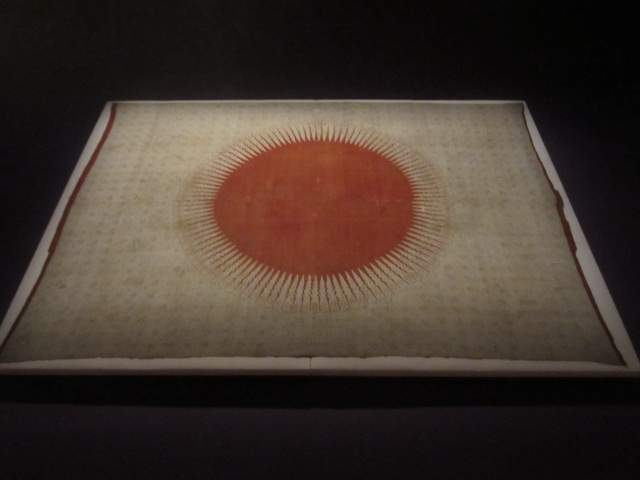
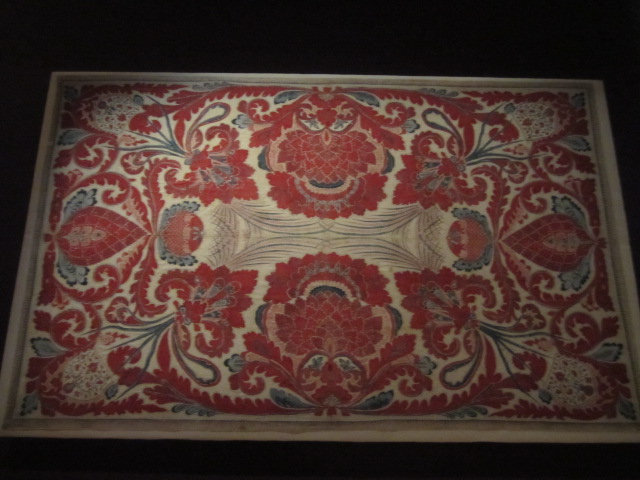
The incomparable favorite is the experiential learning.  The thread from beginning to end of being a consumer of cotton clothing in Mumbai, to reading about Ghandi’s revolution over the textile industry in India, to seeing the cotton mill stack relics turned residences en route to Matunga Market, to our final day of the journey visiting the Patterns of Trade:Indian Textiles for Export 1400-1900 exhibit at the Asian Civilizations Museum in Singapore.  ‘Loved for their quality and their bright and unfading colours, many [Indian textiles] became treasured heirlooms, passed down from generation to generation.’  The Indian textiles were much sought after, well made, vibrant, durable, and came at a better price than any other provider on the market.  It made sense in an imperialistic, sun never sets kind of way why the British moved into Mumbai (then Bombay) in the mid 1800s to ‘own’ the textile industry.  Not sure how long it would have taken for me to extract that arc of discovery from a book.


My appetite for uplifting, hopeful, live-like-you-were-dying material has been insatiable since my return.  It is one Facebook post after another broadcasting words of wisdom from a variety of sources ranging from Harold and Maude quotes to the top five regrets of the dying to Positively Positive.  It is a balm to calm the ache and longing for fresh eyes.

Until I become the change I want to see in the world, that is.  A work in progress… gaining momentum, experience and credibility to start a business that will assimilate all the pieces of me.   The first part of 2012 is already populated with opportunities to disentangle the maelstrom.

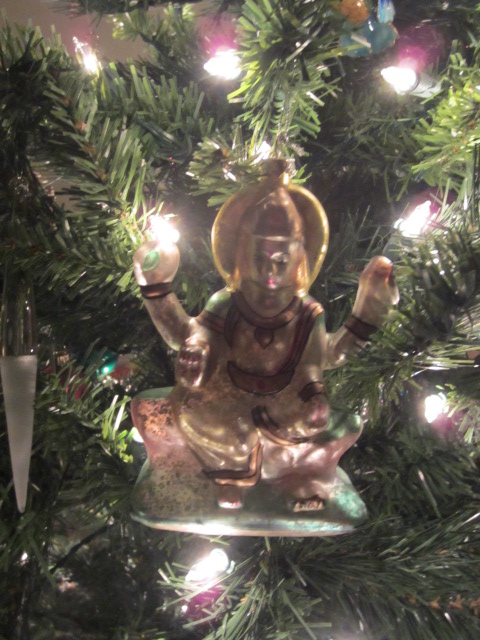
This year’s new Christmas ornament, fittingly, is Lord Shiva.

Posted in Uncategorized | Leave a comment

whole body happy

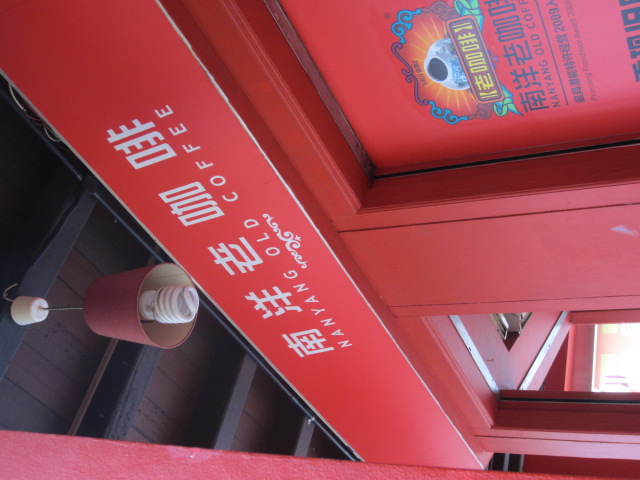
Yesterday, our first day in Singapore, after a night flight, Smith Street and South Bridge Road at Nanyang Old Coffee, where one can rediscover the good taste of old Singapore traditional coffee. This is one dark and delicious cup of coffee.

traditional Singaporean coffee

The rain that was predicted picking up its pace to a full-throttle downpour. Awnings abound to shelter pedestrians from the rain in this year-round hot and humid city. The Lonely Planet guide book offers the striking statistic that lightning strikes this city 170 days every year making it one of the lightning capitals of the world. Thunder rumbled as I was composing that sentence.  This city is known for the strict standards that keep it so clean and orderly.  On the immigration form you are required to complete prior to being permitted entrance to the country, red letters provide the warning that death awaits you for drug trafficking under Singapore law.  Garbage cans read ‘Bin it’ and they work, we haven’t seen anything on the streets or side walks.  This is a dramatic departure from India.  We did get a taste of India taxi driving skills however when our cabbie, a north Indian transplant from 30 years ago, drove backwards for about 2 blocks to avoid the 2 km drive he would have had to manage due to the one-way streets to get us to the front door of our boutique hotel in Chinatown.  Boutique because it is small, has a bit more character and old-world charm with its velvet furniture and fabric-like walls.

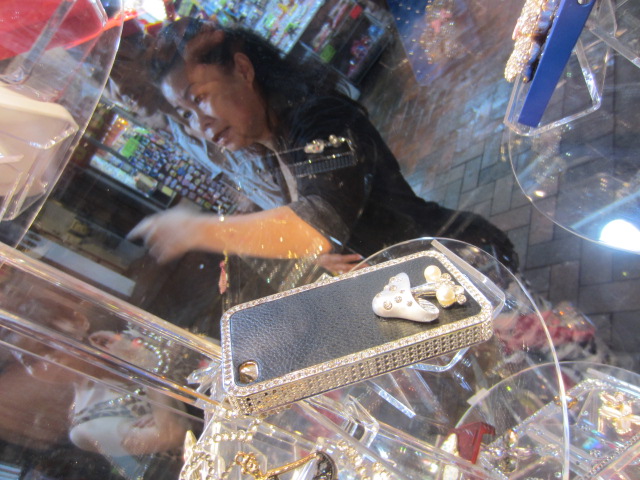
Smith Street is one of the hawker food centers in Chinatown and a few streets over from Pagoda where you can find all kinds of bling for your body and your electronics, as well as many of the items you would find in chinatown in the states, i.e. hand-held fans, chopsticks, clothing, accessories, postcards, magnets, etc.

choosing the bling

While looking at a map posted outside the Chinatown MRT, a vendor chatted me up. I mentioned massage and before I knew it, he was rapidly escorting me to a reputable parlor above his shop. I was only out for a wander with no intentions of receiving body work but when I saw ear-candling on their menu I went for it. For months it feels like there’s water in my ear and with all the flying of late it’s gotten ear-itating (sorry, couldn’t resist). William, an older gentleman, was the practitioner. He kept telling me it was okay to fall asleep as he gave me a preparatory head massage. He was good, it was definitely relaxing and the intended results were achieved. It was a close space where others were receiving reflexology in the dimly lit setting with the sound of the fan and Asian influenced soothing spa sounds. Drifting along, the sound of the sea from the last seven days at Palolem Beach in Goa still rocking me to an internalized soundtrack of ebb and flow.  The other soundtrack from Goa is the light techno ts ts ts ts ambiance set by the establishments along the sea.

Today, December 1

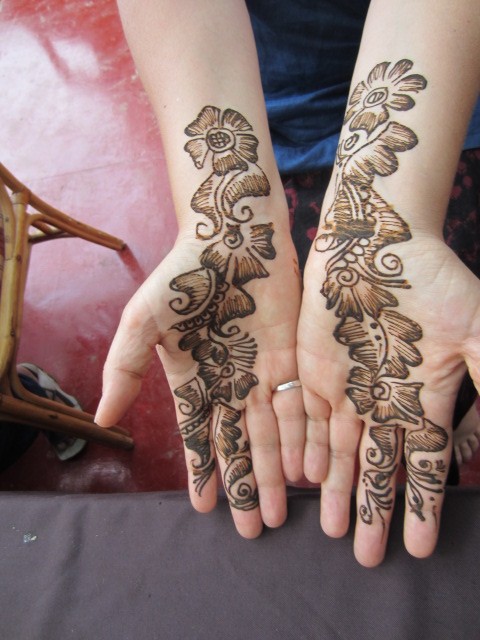
Just tore off the baggage tags that marked our travel from Goa to Singapore through Mumbai (MUM to SIN). Tomorrow evening the bags will be tagged for the final passage from Singapore through Hong Kong to SFO. Sometimes it feels like we’ve been traveling for a month, and other times it feels like just the beginning. Our browned skin is slowly returning to its natural color and the ‘mhendi‘ is growing more faint by the day.

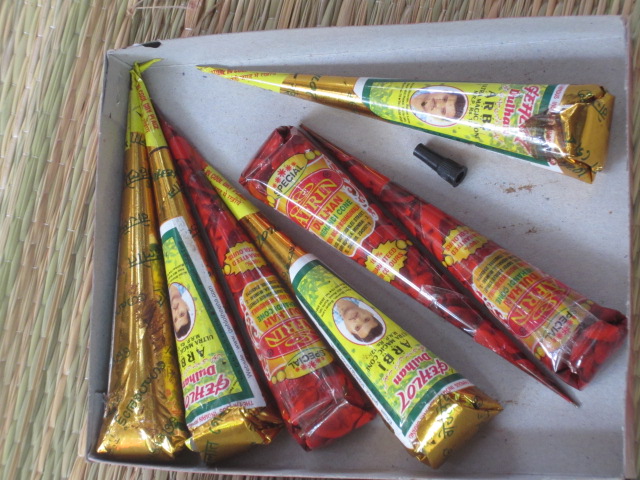
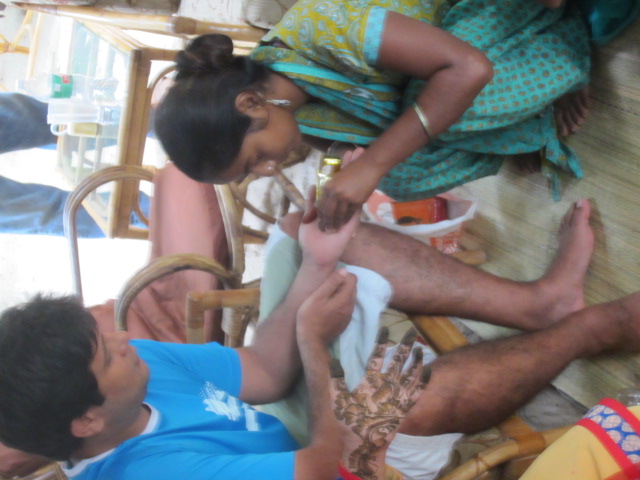
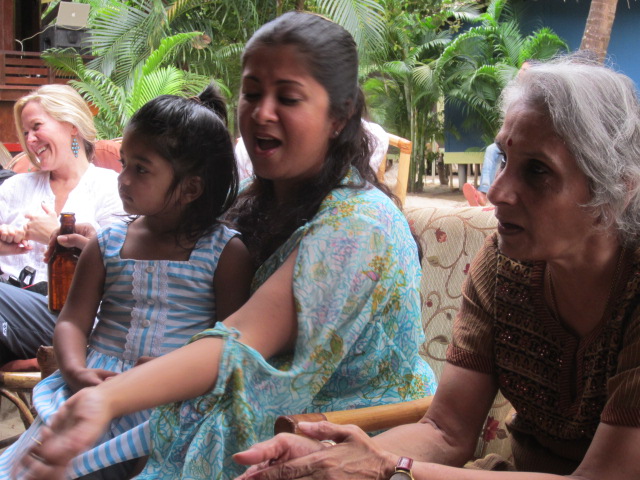
Mhendi is the application of henna on the hands and feet in preparation for celebrations in India. Mhendi comes from Sanskrit and is an ancient Vedic custom symbolically representing the union of the inner and outer sun, meant to awaken the inner light. The groom, Suhaas, also had the likeness of a sun applied to both of his palms, as well as being rubbed down by turmeric by his family and friends to awaken his inner light prior to his embarkation into marriage, one of 16 rites of passage prescribed in the Vedas and performed by a Hindu priest, the purohita. While the mhendi is applied to the bride and female folk the day before the wedding, the women sit in a circle around mats on the ground with the mhendi application at the center. Songs are sung in what is traditionally a kind of sing-off between two camps. Each camp is supposed to have a song ready to go as the other winds down, picking up on the prominent sound from the song just sung in a friendly competition.

Richa singing a song from our camp

The bride to be, Ratnabali, is from

Sushmaa setting the beat for her camp

Calcutta, the capital city in the state of West Bengal. These days it is spelled Kolkata. The day after the wedding I was fortunate to have the opportunity to speak with Ratnabali’s brother, Dwijottam, who goes by Dwijit, pronounced digit. Dwijit provided wonderful insights, context and history for many of my questions, curiosities and observations born of this trip. He explained that many of the songs initiated by the attendees from Calcutta during the mhendi song circle were political in nature, and that in general people originating from Calcutta are sometimes characterized as party-poopers because of this proclivity. The way he described the current state of the de-industrialization and economic impacts on Calcutta, the more it sounded like what has happened in cities like Detroit. He agreed with this comparison and went on to say that despite this decline and the extreme poverty, there is a strong academic vein in Calcutta that you will see represented in the sheer volume of bookstores and in the philosophical discussions that happen throughout the city. The city is known for its revolutionary history and has produced figures known the throughout the world.

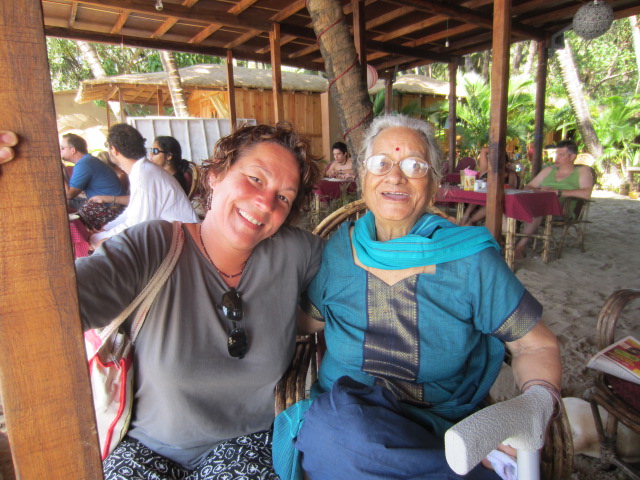
The matriarch within Richa’s family is Prakash Devi Sharma, referred to by most as Nani Ma, she is Sushmaa’s mother, Richa’s grandmother.  She is Punjabi by birth and has covered much territory in her 88 years of life, initiated by the transition to India’s independence.  She has a generous, open-minded, and revolutionary spirit and is an inspiration every day to her family and many others.  At the age of 16 she got involved in India’s move towards independence as a freedom fighter.  She married and raised 5 children.  She has had 5 careers.  She does not like to sit idle and wants to be involved in everything.  She is always dressed to the nines.  She reminds me a lot of my own grandmother and inspires a great affection.

me with Nanima

Back to the mhendi, someone told me that the darker the henna takes to your palms, the more you’re mother in law will love you. The application to the palm does indeed grow darker as the colorant in the henna mixes with the keratin in the skin, naturally more concentrated in the palms. After application you have to keep the hennaed limbs still until it dries and begins to fall off naturally. Ideally twenty-four hours. And since there was a party to get to that evening, the majority of us gave it an hour before accelerating the process in various ways that did not include water because that would initiate the fading. Lunch was served just as the designs were done on my forearms and fingers so while my hands were in the air, Richa fed me (and two other friends who had traveled from the states) a plate of food with her hand in a generous act that felt like the ultimate in nurturing.  Mhendi also became a commerce that served to invite safety and conversation during our travels to Singapore yesterday.  The woman who inspected my passport and paperwork in Singapore met me with a smile and asked questions about the wedding.

Perhaps the degree of darkness on the palm applies more immediately to the morning after application, in which case my mother-in-law and I would have gotten along famously. However, since I don’t have a mother-in-law’s love to win or lose, the fading application and dwindling anti-malaria pills symbolize the return to life as I know it most days of the year, when I am not traveling and having adventures off the beaten path elevating me to a heightened state of awareness and appreciation for this life.  Working on that. On the subject of anti-malaria pills, Dawn made the rather hilarious discovery as we were about to take off from Goa the day before yesterday that she has been dipping into her anti-anxiety pills instead of the anti-malaria pills for a good chunk of his trip.  For the entire week we were in Goa, she slept like a baby and was regularly perplexed with the fact that she was content to stare at the sea for hours while experiencing a dearth of the ‘big thoughts’ that usually accompany journeys like the one we have been on.

Symbolism plays heavily into the customs and traditions leading up to and represented within the actual wedding ceremony. Stories from the Vedic scriptures inform the ceremony and most of them have to do with the bride and groom’s responsibility to each other, their extended families, and of course their yet to be produced but assumed children. Suhaas’ father, Sudhir, performed in the role of the purohita. His combined skills as a performer, natural storyteller, and scholar of the scriptures afforded everyone at the ceremony entrance into a more meaningful experience of the union taking place.

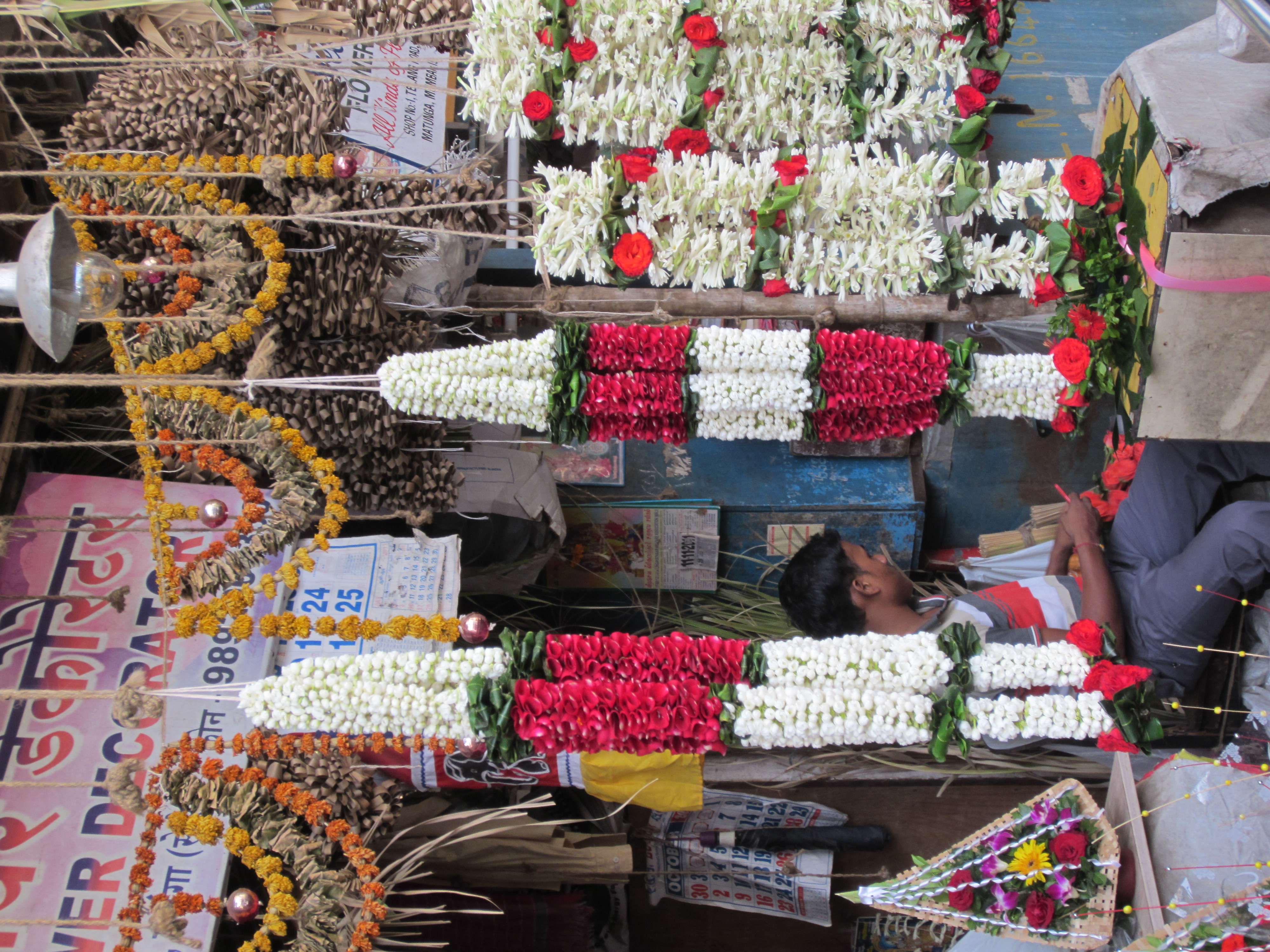
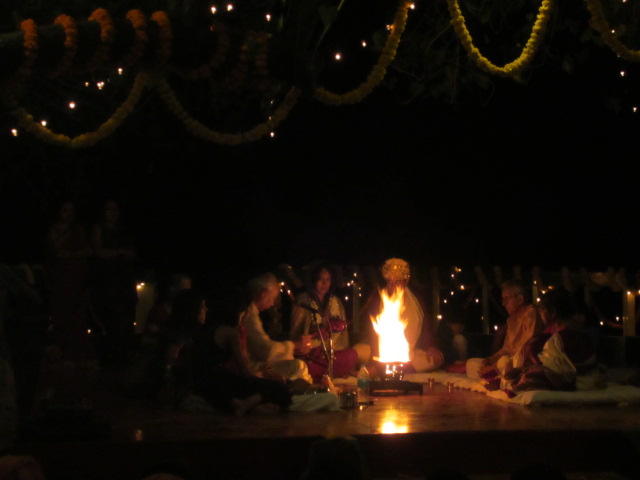
Sudhir started out by telling us we all played an essential role as witnesses to the commitments Suhaas and Ratnabali were about to make, and if at any time in their lives together they went astray, our job was cut out for us to remind them of the way back. The ceremony involved a fire, burning herbs, a symbolic walk around the fire, exchanges of gorgeous floral garlands like the rows of garlands we saw for sale at the Matunga market in Mumbai amongst all the family members, tying together of the bride and groom’s wedding garb, and ultimately the pronouncement that they were man and wife. Both bride and groom were carried to the ceremony by the closest of kin. Everyone I spoke with, including the resident Indians, no matter their state or city of origin, said that the explanation that was part of this ceremony was unique. Typically, the bride and the groom are off in a corner while the rites are performed unintelligibly to those present and the guests, typically quadrupled in size to this ceremony, are milling around waiting for the party to start.

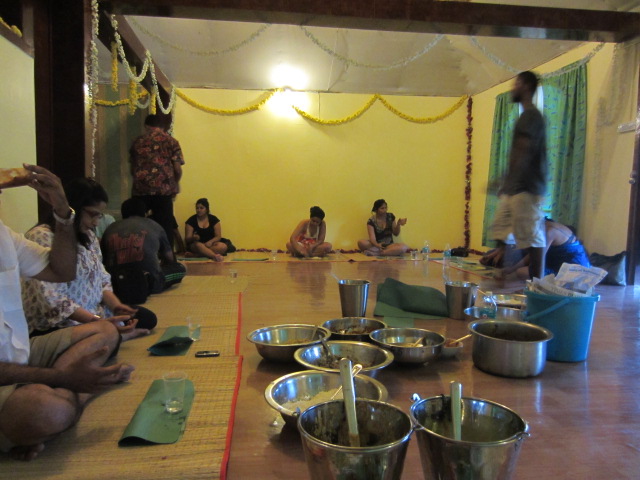
The restaurant area of Dreamcatcher had been transformed during the day to be the site of the ceremony. Furniture re-arranged or removed, strands of yellow and orange marigolds wrapped around branches, banisters, and buildings. The furniture was removed from the Forget-Me-Not cottage immediately next to the restaurant to be the sit-down, cross-legged-on-the-floor location for the

southern Indian style feast

traditional southern Indian feast that was served for lunch with a banana leaf as a plate and only hands for utensils. Strings of white bulbs brought light to the evening proceedings until the power went out. It wasn’t uncommon to experience power outages during our travels while in Goa and Kerala. Usually brief, they were only a nuisance when they happened in the middle of a photo upload to Facebook, or in the middle of a post to the blog. The power outage during the ceremony was prolonged and served to add to the magic, making it more intimate and elemental. The occasional flashes of lightning or gentle showers added excitement from the depression over the Arabian Sea that would bring the tide crashing into restaurants and livelihoods later that evening. A few of us had intentions to cool off in

in the wake of the depression over the Arabian Sea

the sea around midnight until we walked to the shore and saw that the sea had swallowed the thin band of beach that usually allowed passage in the evenings.

threatening sky before the storm

The fire at the center of the ceremony had been lit by the time the power went out and for a significant period of time, the only scene fully illuminated was at the center of the platform over the river that lead to the sea where Suhaas and Ratnabali made their promises to one another.

There were many non-traditional elements and interpretations of more practices typically part of the build-up to and culmination with the wedding ceremony. The night before there is usually a gathering where folk songs are sung and a meal is served. This was interpreted as a party by the sea further down the stretch of Palolem Beach on a rise that was part of another establishment that had a large covered open-air gazebo that became the setting for a talent show and numerous performances. Two of Suhaas’ nieces danced to contemporary Indian songs that will be in my digital library as soon as I get home, including Sheila Ki Javani, doing some fantastic Bollywood moves. Suhaas’ brother, Sourabh, put together a slideshow of images telling the story of Suhaas journey to that day which included an opportunity for his Bahrain contingent of friends to dance in a circle around the grooms parents, Bollywood-style, to honor them. There was an impromptu rendition of ‘if you’re happy and you know it’ with the lyrics changed up around the supplanting of the word for horny to replace happy and performed by three of Ratnabali’s friends that she knows from theater. Richa was the emcee. The final gig was Suhaas performing a few songs with his friends that they’d rehearsed for a few hours earlier that day. Then the feast. Then the walk back to Dreamcatcher along the beach.

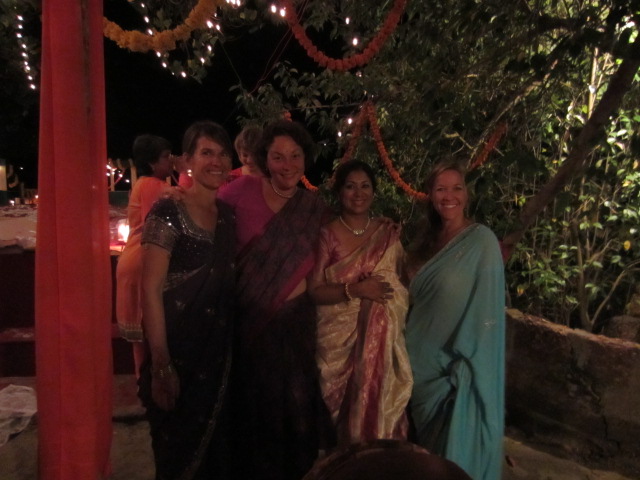
Ratnabali’s father congratulated the couple the day following the wedding for the madness that inspired their choice to hold the ceremony in this place, absent of convention. He summed it up by saying it was the best of god. It was. It also made for a remarkable climax to this journey, in addition to being the originating instigation. There are no words to express my gratitude for being brought into this ceremony with these people in this country where I have wanted to travel for more than half of my life. And I got to wear a sari! I realized the night of the wedding that I never imagined myself in a wedding dress, but I have always wanted to wear a sari.

In a little over twenty-four hours we will be heading to the airport for home. Last night we fed ourselves on hawker fare and experienced the toothless nibbles of garra rufa fish on our feet and hands, referred to as fish therapy.

Maxwell Hawker Center

We shared a couple of Tiger beers and people watched on Pagoda Street. Later this evening, we plan to experience the night safari and have some black pepper crab.  I use the word ‘plan’ because Dawn is having another stomach upset today from the ribs she ate last night.  She has slept most of today while I have worked on this post and had a couple of Singaporean coffees.  

Reading Holy Cow, written by Sarah Macdonald, while traveling through India added a dynamism to this trip.  Her hilarious mix of irreverent observations with details in response to her own soul-searching romp through the religions she encountered while traveling in India has deepened my experience and understanding.  The chapter titled The Big Pot Festival (double entendre and reference to India’s Kumbh Mela) provides her filter and an intro to Hinduism. I quote, “Hinduism is a faith of almost infinite diversity.  Yet the broadest, most complicated religion on the planet actually caters brilliantly to the individual.”  A few paragraphs later, “I like your Jesus and such, and there’s no doubt he was a great sadhu, most likely trained in India, but you know, he was wrong about God.  God is not a judgmental giant sitting up in heaven, it’s a force with us all — we are lightbulbs in the electrical system of the universe.”  That, my friends, is a cosmology I can reckon with.

On the plane from Mumbai to Singapore I watched some Bollywood videos and a dramatic film titled Dhobi Ghat, an overlap of stories set against the Mumbai landscape, including Elephanta Caves, and it caused quite a stir in me.  My love affair with India will continue, I suspect.  Not to mention the Kashmiri men with their dark eyes, long lashes and salesmanship skills.  Dawn is convinced that if I travel to Kashmir the only way I would ever leave is by physical extraction.  Younger guys kept flirting with me throughout the trip too, regularly showing disbelief that I was 44.

We shared our accommodations in Goa with many a creature, frogs in the bathroom, moths and other insects outside the mosquito net, including something that looked like a snap pea, monkeys screeching and crashing through the trees outside.  A dog escorted us all the way home from a fitting and delicious final meal of king prawns, snapper and chicken prepared tandoori- style at a restaurant called Dropadi along the sea with Richa and Kash our

tiny and beautiful

last night in Goa.  That dog got punked out by every other territorial dog along the trek home and would most likely have the same experience when he walked back.  The dogs along Palolem Beach definitely hang in defined posses and have their own caste system going on.  It got to the point where I didn’t even flinch to take a picture of another cow in the road, like not just on the side of the road, but full-on lying in the middle of the road.  We really bonded with the guys that took care of us in restaurants and cyber cafes on this trip and saying goodbye was hard.  Without fail, their goodbyes always included a genuine expression of their hope we would be back next year.  I hadn’t made an emotional connection to these words until that last line.  The tears are welling up, and I need to get out of this Singaporean cyberspace to see if we’re heading to the night safari.  Plus the rank baby-poop smell of durian fruit is getting to me.

posted by the elevators in our hotel

Have you ever watched the way babies sleep? Their little limbs and neck all floppy in a whole body surrender? The build-up and residue of stress not yet introduced, they haven’t yet amassed the layers of protection we all tend to assume in our structures of origins, family or otherwise. We craft our mask with some idea of who we’re supposed to be, or need to be, out of sync by degrees with the original self. Then, if you choose a path towards re-integration or have a taste for self-awareness, perhaps you find some tools, disciplines, practices, support to dissolve again into that surrender for brief spells of time, no separation or resistance, just an acceptance of what is. This is the state of being, not mind, I arrived at by the end of the journey and particularly the week at Dreamcatcher on Palolem Beach in a cottage called Bliss. Whole-body happy.  

Posted in Uncategorized | 1 Comment